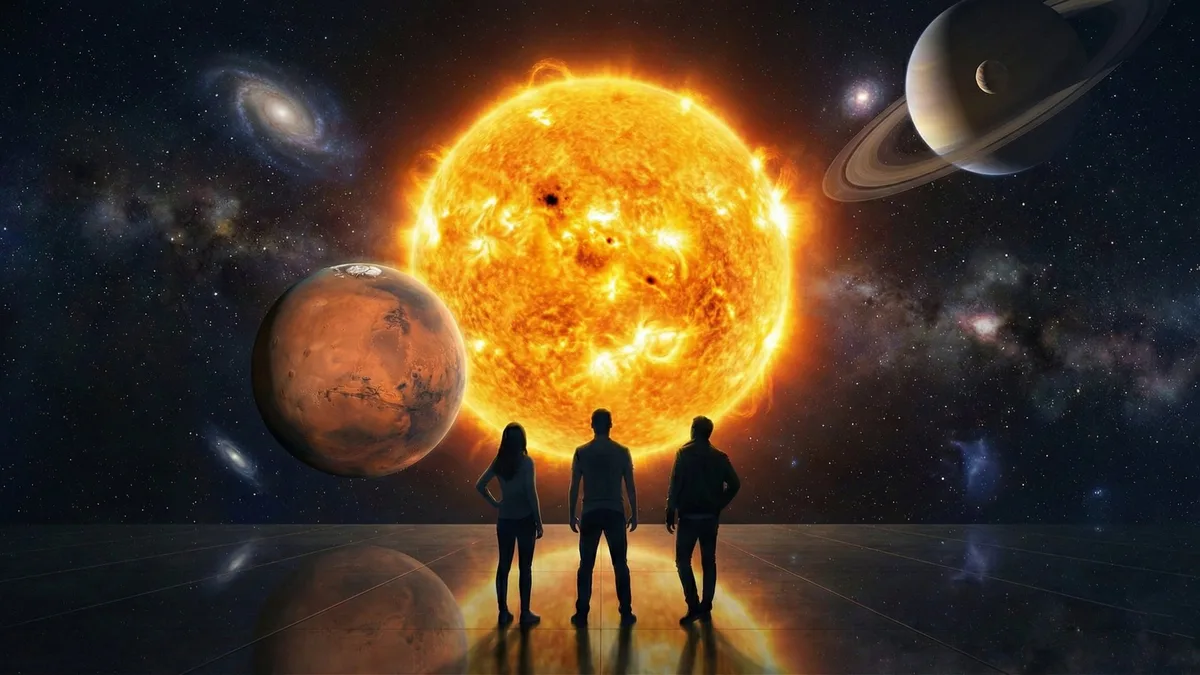
Mars six to ten feet in front of you. Walk around it. Walk through it. Look at it from above and below. Beethoven playing while the cosmos fills the room around you. This is the only experience like it in Northeast Florida.
Every description of Star Walk mentions planets and the solar system. What those descriptions miss — what you genuinely cannot understand until you're standing inside the room with the glasses on — is the scale.
Mars appears in the middle of the room at roughly six to ten feet in diameter. Not a model of Mars. Not a picture of Mars. A holographic Mars, in three dimensions, large enough that you can walk toward it, around it, past it, and — if you choose — straight through it. The red surface detail is visible. The polar ice caps are there. You can look at it from the side, tilt your head to see the top, crouch to look at it from below.
The other planets are rendered similarly. The Sun blazes and fills a significant portion of the room. Saturn's rings extend outward in actual three-dimensional space around you. This is not a screen you look at. This is a solar system you stand inside.
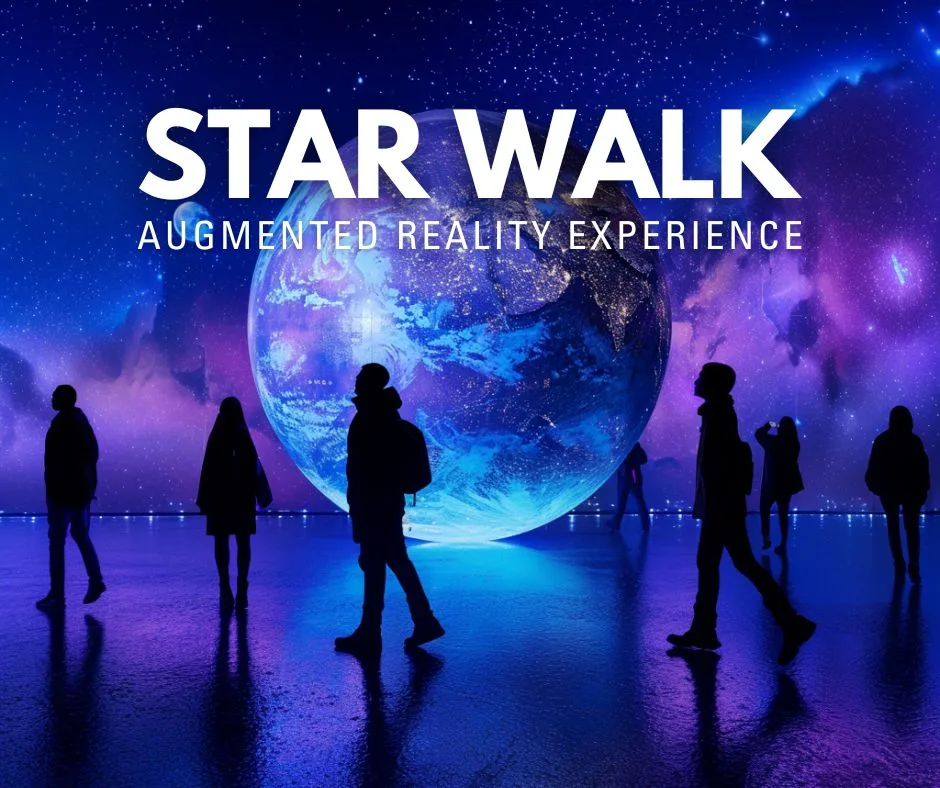
Star Walk at Mind Bender AR — Earth appears in the physical room, rendered in holographic 3D through Snap Spectacles glasses
There's a specific moment in Star Walk — it happens to almost everyone on their first visit — where you look at a planet filling the room around you, remember that you're standing in Jacksonville Beach in a room on Beach Boulevard, and the two facts simply refuse to coexist. That's when the experience earns its reputation.
Star Walk is divided into multiple acts, each introducing a new region of the cosmos. The experience begins in our solar system and expands outward — past nearby stars, through the Milky Way, and eventually to structures so vast they reframe everything you thought you understood about scale.
The centerpiece for most guests. Appears at roughly 6–10 feet in diameter — large enough to walk around on all sides, look at from above and below, and walk directly through. Surface detail, color, and polar regions visible. The first planet that makes guests stop talking.
Enormous, blazing, and rendered with the kind of detail that makes the 93-million-mile distance feel suddenly, absurdly small. The Sun fills a significant portion of the room. Most guests instinctively step back when it first appears — even knowing it isn't real.
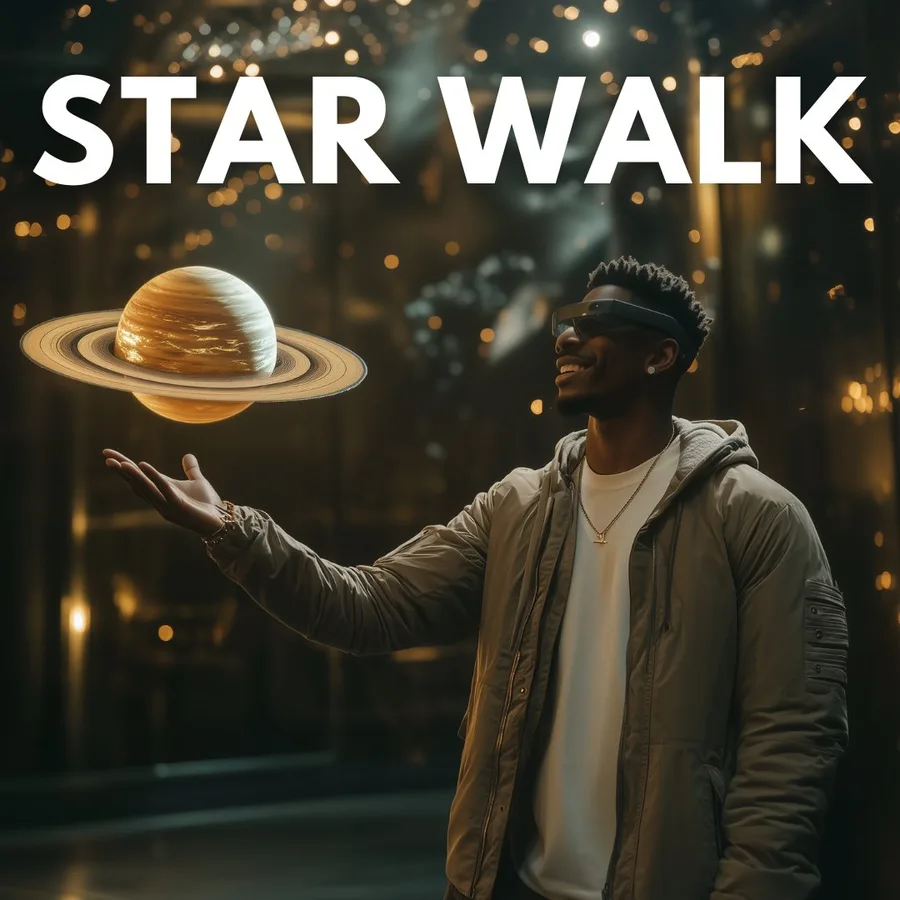
Saturn with its rings rendered in three-dimensional augmented reality is one of those things that photographs cannot capture. The rings extend outward into the room around you. You can walk around the planet and watch the rings from different angles. It's extraordinary.
The nearest star system to Earth — 4.37 light years away — rendered here in the same room where you just stood next to Mars. The scale transition from solar system to interstellar space is one of the most affecting moments in the experience.
500 million light years across. Home to our Milky Way along with 100,000 other galaxies. When Star Walk expands to this scale, the human brain genuinely struggles to process what it's seeing. It's the most quietly overwhelming moment in the experience.
In 1977, a radio telescope at Ohio State University detected a 72-second signal from space that has never been explained. Star Walk includes this real scientific mystery — one of the details that separates it from pure entertainment and into something more thoughtful.
Star Walk is free-roam — you walk where you want, look at what interests you, and interact with what you find. There's no prescribed path, no penalty for going your own direction. The experience unfolds around you as you explore. Here's what you'll encounter, along with an honest take on each.
The signature move of Star Walk — and the one that gets guests every time. Pick a planet, walk toward it, and keep walking. The holographic surface passes around you. You're inside a planet for a moment. Then you step out the other side. Nothing else you can do in Jacksonville Beach produces this particular sensation.
★ Standout MomentHolographic asteroids appear and you destroy them using throwing motions — your actual arm, your actual throw, tracked by the glasses cameras. It's genuinely satisfying in the way that throwing things and hitting targets always is. The honest note: there could be more of it. The asteroid segments feel short. They're a highlight worth leaning into while they last.
★ Most Fun InteractionAs you encounter each celestial object, trivia questions appear about it — facts about Mars, the Sun, Saturn, and beyond. You answer using hand gestures. This is what makes Star Walk genuinely educational rather than merely spectacular. It works particularly well for curious kids and anyone who wants more than visual spectacle.
★ Museum-Level EducationalStar Walk includes text segments — information about the cosmos that appears as readable content within the experience. These are less engaging than the interactive elements. If reading in a dark room while wearing AR glasses isn't your idea of a good time, you won't miss much by skimming them. The trivia and the planets themselves are where Star Walk shines.
Honest Take — Less Engaging
Saturn's rings — rendered in three-dimensional augmented reality at Mind Bender AR, Jacksonville Beach
Star Walk doesn't just show you the solar system. It takes you through a sequence of scale shifts — each one larger than the last — that by the end produces a specific kind of quiet that not many entertainment experiences manage. You start in our neighborhood. You end somewhere that has no neighborhood at all.
Sun, Mars, Saturn, Earth. Human scale. Room scale. Walk through them.
Alpha Centauri — 4.37 light years. The nearest star system. Still unimaginably far.
Our galaxy. 100,000 light years across. Our sun is one of 200–400 billion stars.
500 million light years. 100,000 galaxies. The structure our Milky Way calls home.
Verse Immersive could have chosen ambient electronic music for Star Walk. Something designed-for-space, atmospheric and expected. Instead they chose Beethoven — and it turns out that classical music and a holographic solar system are a combination that nobody anticipated and everyone remembers.
The reason it works is that Beethoven already contains the full range of human emotional response — wonder, awe, smallness, joy. When the strings swell as Mars fills the room in front of you, the music doesn't comment on the moment from outside it. It becomes part of the moment. The cosmos and the composer occupy the same space and somehow both feel more real for it.
Guests who describe themselves as not particularly interested in classical music still consistently mention the Beethoven as one of the things they remember most about Star Walk. It's not background music. It's a co-author of the experience.
The owner of Mind Bender AR has done Star Walk himself — more than once. His take: it's the better of the two experiences. The scale is more impressive, the asteroid smashing is more fun, and the Beethoven transforms what could be a tech demo into something genuinely moving. The reading segments are less engaging. There could be more asteroid smashing. Both are fair criticisms. The experience is still extraordinary.
The owner's honest take: Star Walk is the better of the two experiences. The scale alone justifies the visit. If you're doing one, do Star Walk. If you're doing both, save Star Walk for last — you'll want the cosmos to be the thing you're still thinking about when you walk out.
Sessions sell out on weekends. Book online to guarantee your spot — or call us if you'd like help choosing the right option for your group.
Book Now — Star Walk Multi-Pass: Star Walk + Unreal GardenQuestions? Call (904) 853-6192
Mars six feet in front of you. Saturn's rings overhead. Beethoven playing. This is the only experience like it in Northeast Florida — and it won't be a secret for long.